
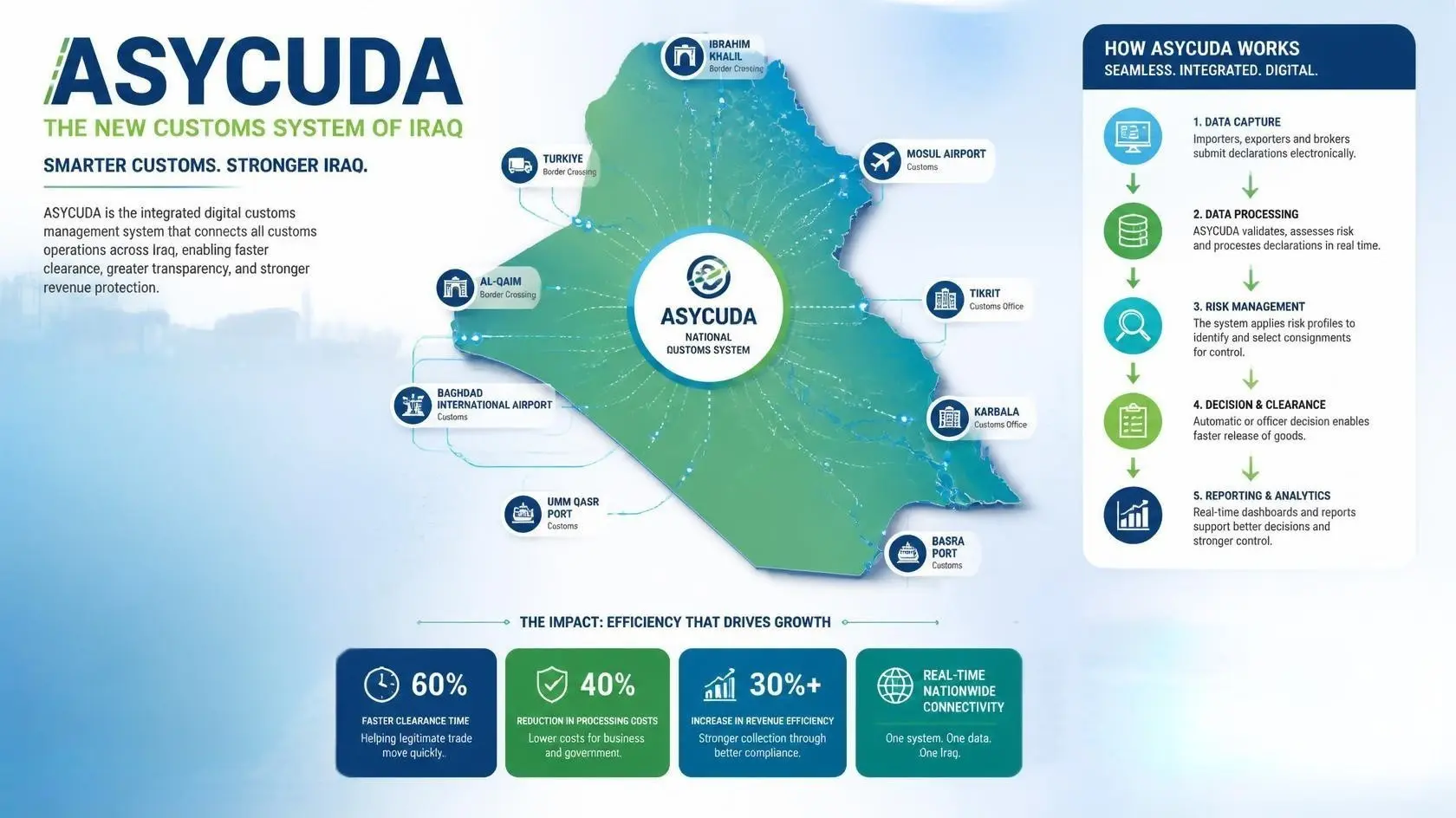
How Iraq’s digital customs transformation is creating faster, more transparent and more connected trade — and what it means for businesses in the Kurdistan Region
Iraq is entering an important new chapter in the digital transformation of international trade.
At the center of this transformation is ASYCUDA — the Automated System for Customs Data, a customs-management platform developed by the United Nations Conference on Trade and Development (UNCTAD).
For importers, exporters, customs brokers, transport companies, freight forwarders and logistics providers, ASYCUDA represents much more than a new customs website or electronic declaration system. It is part of a broader modernization of how goods, documents, payments and customs information move through Iraq’s borders.
Iraq’s Federal Customs Authority has already introduced electronic customs procedures across its federal customs network, including electronic declarations, e-manifests, electronic payments, automated clearance processes, risk-management tools and data exchange with other government institutions.
In 2026, attention has increasingly turned toward integrating the Kurdistan Region of Iraq into the wider ASYCUDA framework. Iraqi and Kurdistan Region officials signed a 16-point Letter of Agreement concerning implementation, with practical preparations and employee training reported as beginning in August 2026.
For the Iraqi economy, the potential significance is substantial: one more connected customs environment, better-quality trade data, greater transparency and a more predictable process for moving goods across borders.
What Is ASYCUDA and Why Is It Important for Iraq?
ASYCUDA stands for Automated System for Customs Data.
Developed by UNCTAD, ASYCUDA is designed to automate and modernize customs procedures by moving customs declarations, manifests, payments, documentation and related processes into an integrated electronic environment.
Instead of relying heavily on disconnected paper-based procedures and manual processing, customs authorities can use a centralized digital system to manage information throughout the import and export process.
Iraq’s ASYCUDA program is being implemented through the Ministry of Finance and the General Customs Authority in cooperation with UNCTAD. The Iraqi Ministry of Finance describes the program as a multi-phase modernization project designed to introduce modern customs procedures, electronic documentation, pre-arrival processing, risk analysis, post-clearance auditing and greater integration with other government systems.
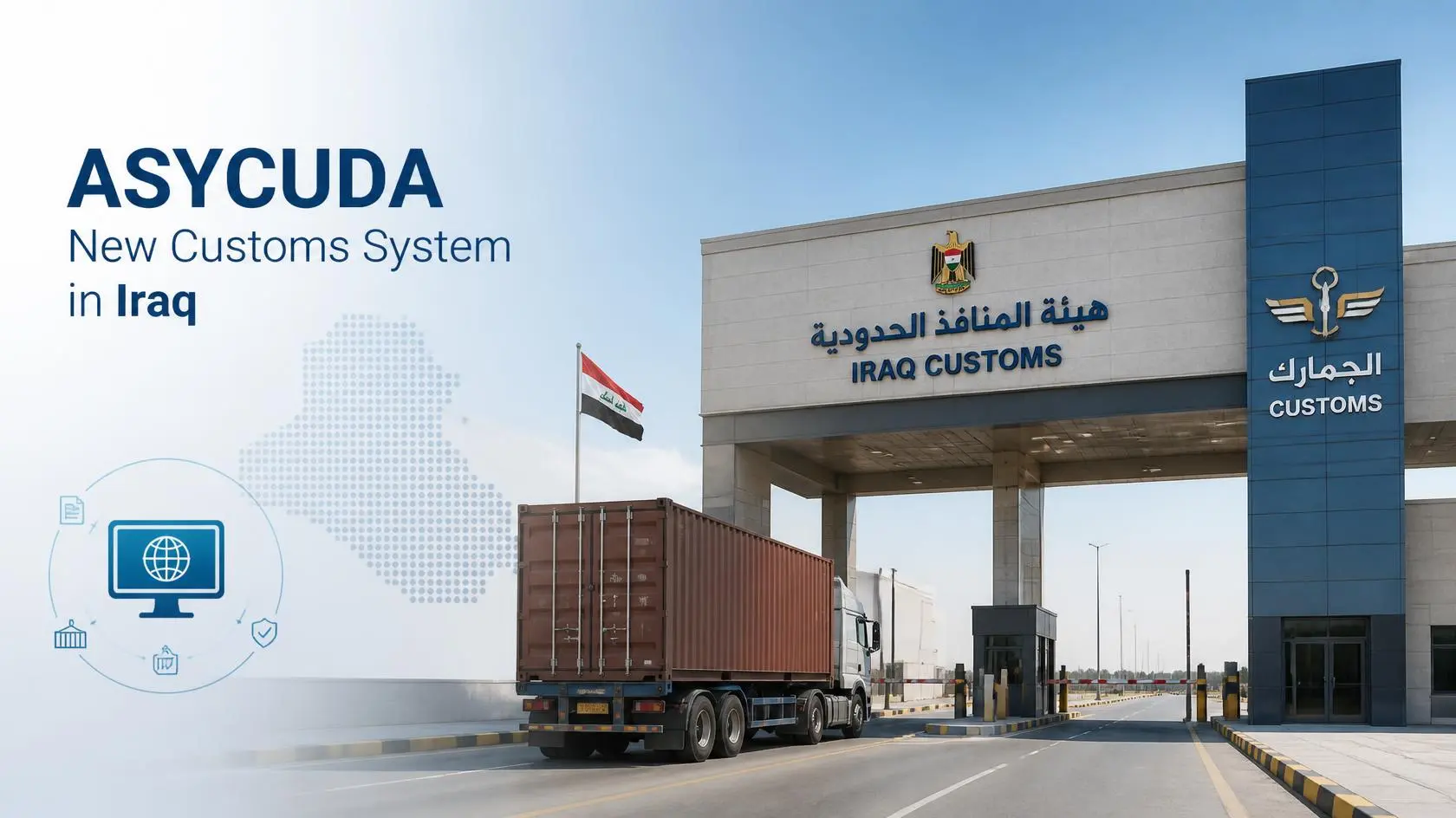
In simple terms, ASYCUDA helps answer five important questions:
- What is entering or leaving Iraq?
- Who is importing or exporting it?
- What is the value and classification of the goods?
- What customs duties and other charges apply?
- Has the shipment completed the required customs procedures?
When these answers are captured electronically and consistently, customs authorities and businesses can work from the same information.
How ASYCUDA Works
The major change introduced by ASYCUDA is the digitalization of the customs transaction.
A typical process can involve:
Transport manifest → Customs declaration → Document verification → Risk assessment → Inspection, where required → Customs valuation → Payment → Customs release
The objective is not simply to make customs “paperless.” It is to create a more structured process in which information can be shared between the relevant authorities and businesses.
Iraq has already activated several important ASYCUDA functions, including electronic manifests, electronic declarations, electronic payment, export processing, land-transport clearance, exemptions and electronic information exchange.
The Main Benefits of ASYCUDA for Iraq
Faster Customs Clearance
Digital processing can reduce unnecessary manual steps and repeated data entry.
For businesses, faster clearance can mean:
- Less cargo waiting time
- Better truck utilization
- Lower storage and demurrage exposure
- Faster delivery to customers
- More predictable logistics planning
The Iraqi system has already automated customs processing from manifest acceptance through electronic payment and release at participating customs centers.
Better Customs Revenue Collection
A digital customs system provides authorities with better visibility over declarations, values, classifications and payments.
This can help reduce revenue leakage and improve the accuracy of customs collection.
The Iraqi Customs Authority has reported significant increases in customs revenue following the wider implementation of ASYCUDA, although individual revenue figures should be understood in the context of broader economic and regulatory changes as well as the customs reform itself.
Stronger Risk Management
Modern customs administration is not about physically inspecting every shipment.
A more effective model is to use available data to identify shipments that may require additional examination while allowing lower-risk shipments to move more efficiently.
Iraq’s ASYCUDA program includes pre-arrival risk analysis, smart selectivity and post-clearance audit as part of its modernization strategy.
Less Paperwork
Electronic declarations, e-manifests and digital document verification can significantly reduce dependence on physical paperwork.
Iraq moved from paper customs declarations toward electronic declarations from January 1, 2025.
This is particularly important for companies handling hundreds or thousands of shipments each year.
ASYCUDA and Business Transparency
One of the most important long-term benefits of customs digitalization is transparency.
A digital customs transaction creates a structured electronic record of the shipment and its associated documentation.
This can make it easier to:
- Track declarations
- Verify submitted information
- Monitor customs payments
- Reduce discretionary manual intervention
- Identify inconsistencies
- Audit transactions after clearance
- Improve accountability
- Share information between government agencies
In June 2026, Iraq’s customs authorities also announced electronic verification of certificates of origin and commercial invoices through integration with ASYCUDA. The service was scheduled to become mandatory from July 10, 2026, meaning documents that cannot be electronically verified would no longer be accepted under the announced procedure.
For legitimate businesses, this creates an important advantage: clearer rules and better traceability can reduce uncertainty.
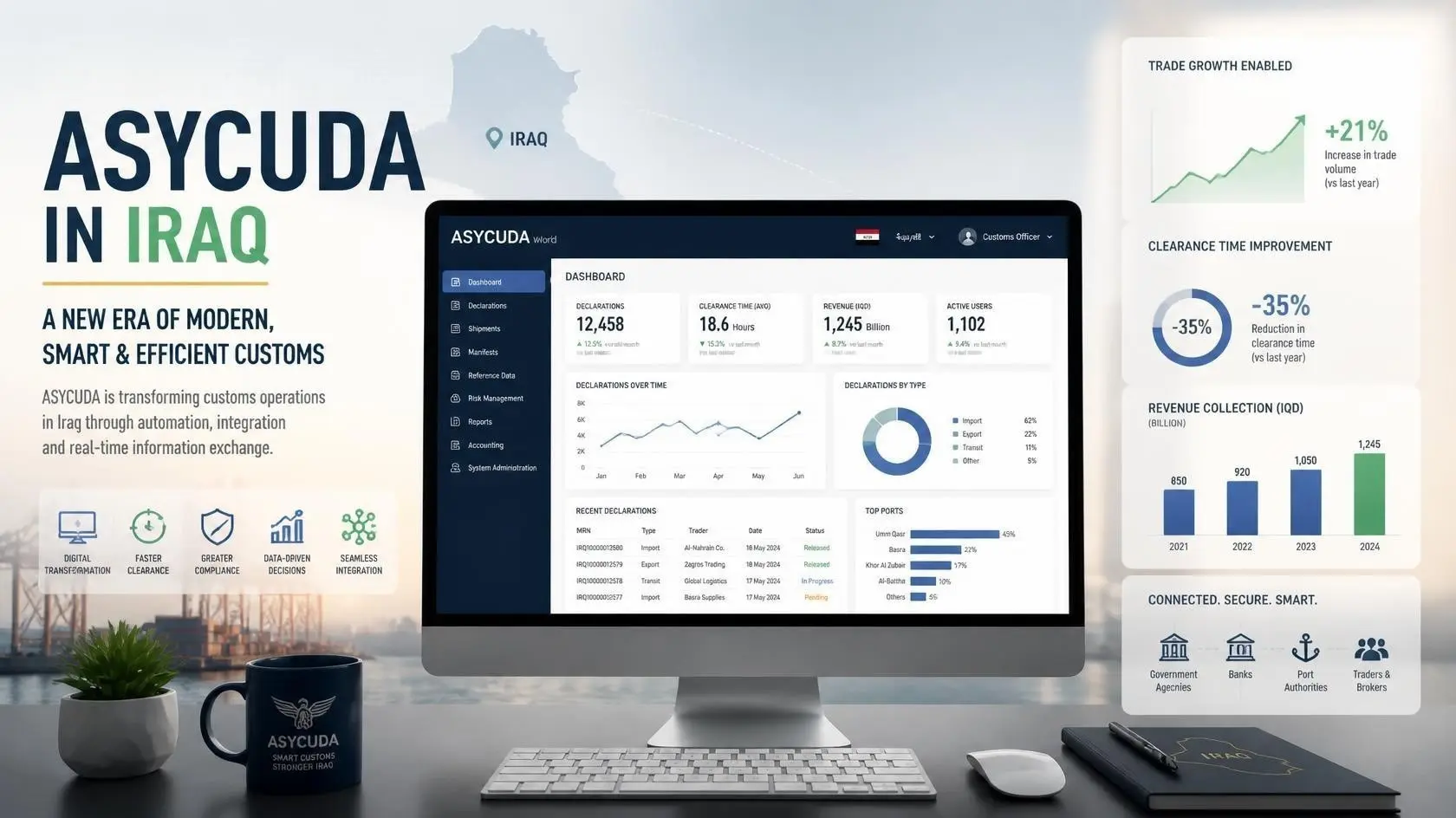
What Does ASYCUDA Mean for the Kurdistan Region of Iraq?
The Kurdistan Region is strategically important to Iraq’s international trade because of its geographical position and its major trade corridors with Turkey and Iran.
Border crossings such as Ibrahim Khalil, Bashmakh and Parvizkhan are important gateways for commercial traffic.
Historically, differences between federal and regional customs procedures have created challenges for businesses moving goods between the Kurdistan Region and federal Iraq.
The planned integration of the Kurdistan Region into ASYCUDA therefore has implications beyond technology.
It can potentially create a more unified customs environment between Erbil and Baghdad, improving the consistency of customs procedures and reducing uncertainty for traders.
In June 2026, representatives from the Kurdistan Region and Iraq’s General Commission of Customs signed a 16-point Letter of Agreement concerning ASYCUDA implementation. Subsequent reporting indicated that practical preparations, including staff training, were expected to begin in August 2026.
Potential Benefits for Kurdistan Region Businesses
If implementation proceeds effectively, businesses in the Kurdistan Region could benefit from:
- More standardized customs procedures
- Greater visibility of customs requirements
- Improved electronic documentation
- Better coordination with federal customs
- Easier movement of goods into wider Iraqi markets
- Improved data consistency
- More predictable customs processing
- Greater integration with national trade systems
This is especially relevant for importers and exporters who operate across both the Kurdistan Region and federal Iraq.
ASYCUDA and Freight Forwarding Companies in Iraq
The logistics and freight-forwarding industry is one of the sectors most directly affected by customs digitalization.
A freight forwarder often sits between the importer, exporter, carrier, customs broker, customs authority, warehouse and other service providers.
That means the quality of customs information can directly affect the efficiency of the entire supply chain.
Better Shipment Visibility
Electronic manifests and declarations allow logistics companies to work with structured shipment information rather than relying entirely on documents exchanged manually.
This can improve:
Planning → Documentation → Customs processing → Delivery scheduling
More Efficient Truck Operations
For road freight companies, time at the border has a direct commercial cost.
A truck that is waiting for documentation, inspection or payment is not generating productive transport capacity.
Better customs coordination can therefore contribute to:
- Faster truck turnaround
- Better fleet utilization
- Improved delivery scheduling
- Lower waiting costs
- More reliable customer service
Improved Documentation Management
Freight forwarders routinely manage commercial invoices, packing lists, certificates of origin, manifests and customs declarations.
As more of these processes become electronic, companies can reduce repetitive data entry and improve document consistency.
Iraq’s official ASYCUDA service documentation specifically provides processes for transport companies to submit manifest information electronically, including through XML data exchange or manual entry.
Why ASYCUDA Matters to Logistics Performance
The biggest opportunity is not simply “faster customs.”
The bigger opportunity is predictability.
For logistics companies, predictable clearance is often more valuable than simply having a fast clearance process.
When a freight forwarder can better estimate:
- Border processing time
- Documentation requirements
- Customs payments
- Inspection probability
- Delivery timing
it becomes easier to provide accurate quotations and delivery schedules to customers.
This can improve the competitiveness of Iraqi logistics companies and make Iraq’s trade corridors more attractive to international businesses.
Benefits for Importers and Exporters
For businesses involved in international trade, ASYCUDA can provide several practical benefits.
Greater Predictability
Businesses can better understand where their shipment is within the customs process.
Electronic Payments
Iraq has integrated electronic payment functionality into ASYCUDA, including POS and web-based payment mechanisms.
Better Document Verification
Electronic verification of commercial documents can help identify incorrect or invalid documentation before it causes larger problems in the clearance process.
Improved Compliance
A structured digital system makes it increasingly important for companies to maintain accurate:
- HS classifications
- Commercial values
- Country-of-origin information
- Invoices
- Packing lists
- Transport documents
- Import licenses and supporting documents
For professional importers, this can encourage stronger internal compliance systems.
ASYCUDA and the Future of Trade in Iraq
ASYCUDA should be viewed as one part of a much larger digital trade ecosystem.
Iraq’s stated expansion plans include connecting customs with other government institutions, including border authorities, the Central Bank, transport-related entities and other agencies. The program also envisages further electronic data exchange and links with neighboring countries’ customs systems.
This could eventually support a more connected trade environment where information does not need to be repeatedly submitted to different authorities.
From Customs Automation to Digital Trade
The long-term vision can be summarized as:
Paper → Electronic Documents → Integrated Data → Risk-Based Controls → Connected Trade
This is the direction in which modern customs administrations around the world are moving.
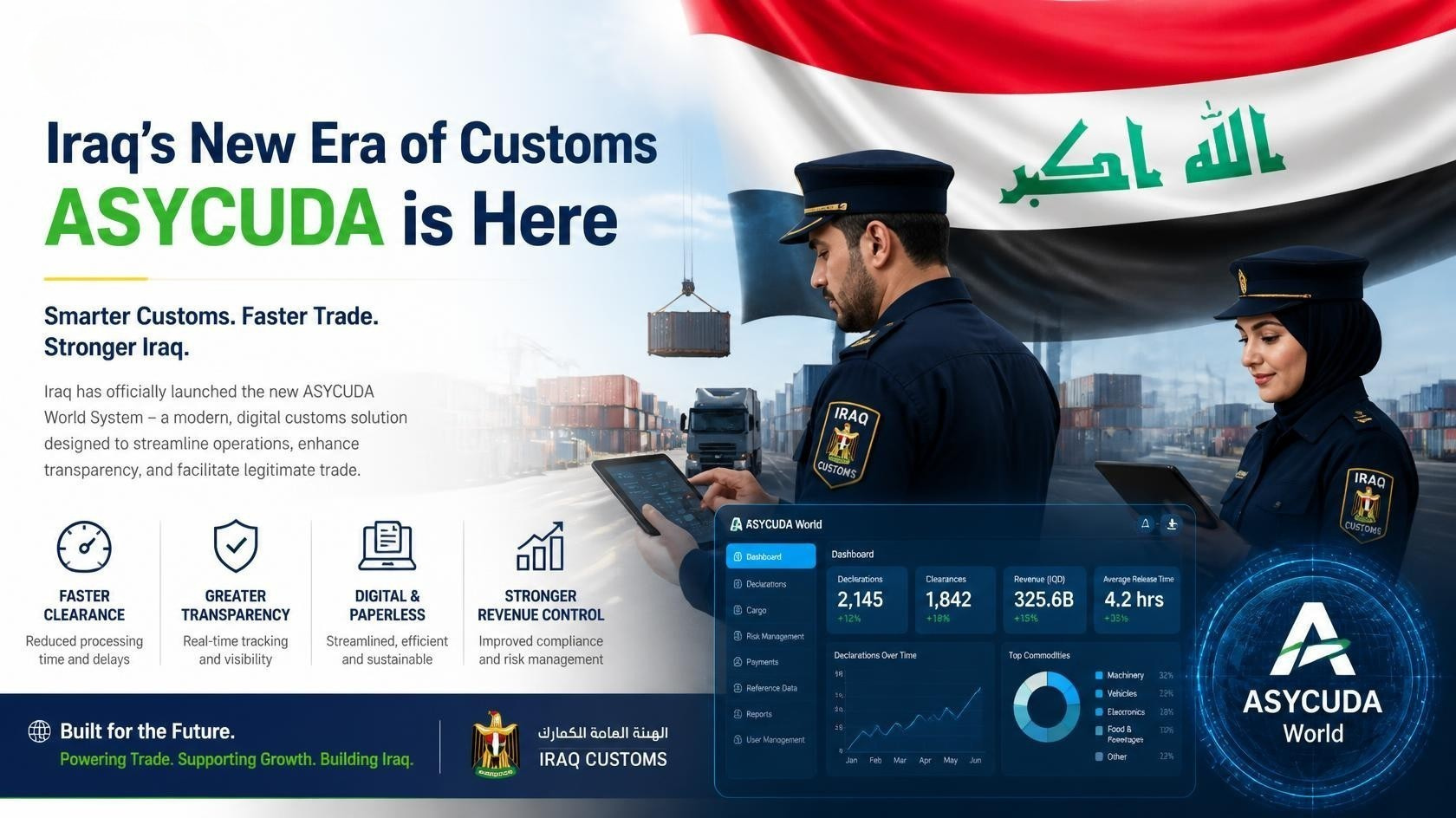
What ASYCUDA Could Mean for International Investors
Transparency and predictability are important considerations for companies deciding where to invest or establish supply-chain operations.
A more standardized customs environment can help international companies understand:
- Import procedures
- Documentation requirements
- Customs valuation
- Payment procedures
- Clearance processes
- Compliance obligations
Greater digital traceability can also support better corporate governance and internal auditing.
For Iraq, this matters because improving the trade environment is not only about increasing government revenue. It is also about creating conditions in which legitimate businesses can plan, invest and grow with greater confidence.
Challenges Businesses Should Prepare For
Digital transformation also creates new responsibilities.
Companies should not assume that moving from paper to electronic customs automatically eliminates every logistics problem.
During implementation, businesses may experience:
- Learning curves
- New registration requirements
- Technical issues
- Data-entry errors
- System integration challenges
- Changes to customs procedures
- Additional compliance requirements
- Temporary delays while staff adapt
The best approach is preparation rather than waiting until a shipment reaches the border.
How Businesses Can Prepare
Importers, exporters and freight forwarders should consider:
- Reviewing their customs documentation processes.
- Checking that commercial invoices and certificates of origin contain accurate information.
- Training staff on ASYCUDA procedures.
- Maintaining accurate shipment and product data.
- Reviewing HS codes and customs classifications.
- Strengthening communication between logistics, finance and customs teams.
- Working with experienced customs brokers and freight forwarders.
- Preparing digital versions of required documents.
- Monitoring official customs announcements.
- Building sufficient time into the first shipments during the transition period.
ASYCUDA for Iraq: The Bigger Picture
The introduction of ASYCUDA is ultimately about more than customs technology.
It is about building a more connected trade infrastructure for Iraq.
When customs data, payments, transport information, commercial documents and government systems can communicate more effectively, the entire supply chain can benefit.
For government, this can mean stronger revenue collection and oversight.
For businesses, it can mean greater predictability and transparency.
For freight forwarders, it can mean more efficient shipment management.
For transport companies, it can mean better truck utilization.
For importers and exporters, it can mean clearer procedures and better visibility.
And for the economy as a whole, it can support a more modern and competitive trading environment.
Frequently Asked Questions About ASYCUDA in Iraq
What does ASYCUDA stand for?
ASYCUDA stands for Automated System for Customs Data. It is a customs-management and trade-facilitation system developed by UNCTAD.
Is ASYCUDA already implemented in Iraq?
Yes. Iraq has implemented ASYCUDA across its federal customs network and has introduced electronic declarations, manifests, payments and other digital customs functions.
Is ASYCUDA being implemented in the Kurdistan Region?
The Kurdistan Region and Iraqi federal authorities reached an agreement framework for implementation in June 2026. Reports in June indicated that practical implementation and staff training were expected to begin in August 2026. The rollout should therefore be understood as an implementation process rather than assuming every regional border procedure is already identical to the federal system.
How does ASYCUDA benefit freight forwarders?
It can improve electronic documentation, manifest submission, customs visibility, payment processing, compliance and coordination between freight forwarders and customs authorities.
Can ASYCUDA reduce customs clearance time?
It can help reduce unnecessary manual processing and improve workflow. Actual clearance time will still depend on the shipment, documentation, inspection requirements, customs procedures and the operational performance of the relevant border crossing.
Does ASYCUDA improve transparency?
Yes. A centralized electronic customs environment creates more structured records and can improve traceability, verification, auditing and information sharing.
Does ASYCUDA eliminate customs inspections?
No. ASYCUDA supports risk-based customs management; it does not mean every shipment will automatically bypass inspection.
Will ASYCUDA help businesses operating between Kurdistan and federal Iraq?
A successful integration could make customs procedures more standardized and improve the flow of information between regional and federal systems. The practical benefit will depend on how effectively implementation, technical integration and procedures are harmonized.
What should importers do now?
Importers should make sure their commercial documents and shipment data are accurate, understand current customs requirements, train relevant staff and work with experienced customs and logistics partners.
ASYCUDA Iraq
Overview
- What is ASYCUDA?
- ASYCUDA in Iraq
- ASYCUDA in Kurdistan Region
- Digital Customs
For Businesses
- Importers
- Exporters
- Customs Brokers
- Freight Forwarders
- Transport Companies
Trade & Logistics
- Electronic Manifests
- Electronic Declarations
- Customs Clearance
- Electronic Payments
- Risk Management
- Document Verification
Business Benefits
- Transparency
- Compliance
- Faster Processing
- Better Visibility
- Cost Control
- Supply Chain Efficiency
Get Expert Support With Your Iraq Customs & Logistics Operations
Are you importing, exporting or moving cargo through Iraq or the Kurdistan Region?
Connect with our team to discuss customs procedures, freight forwarding, documentation and logistics planning.
Suggested form fields:
- Full Name
- Company Name
- Phone / WhatsApp
- Country
- Shipment Type
- Origin
- Destination
- Cargo Type
- Message
PRICING
ASYCUDA Readiness & Logistics Support
Basic — Documentation Review
For businesses preparing their first ASYCUDA shipments.
Includes:
- Document checklist
- Shipment information review
- Basic customs-process guidance
Professional — Trade & Customs Support
For regular importers, exporters and logistics companies.
Includes:
- Documentation review
- Shipment-process guidance
- Customs workflow support
- Logistics coordination
Enterprise — Supply Chain & Customs Advisory
For companies managing regular or high-volume international trade.
Includes:
- Process assessment
- Customs and logistics workflow review
- Compliance support
- Freight-forwarding coordination
- Ongoing advisory
Note: Service pricing should be customized according to shipment volume, cargo type, origin/destination and required support.
Latest Iraq Trade & Customs Updates
Use this section dynamically on the website to display:
- Latest ASYCUDA announcements
- Iraq customs updates
- Kurdistan Region customs developments
- Border-crossing news
- Import/export regulations
- Logistics and freight-forwarding updates
- Trade facilitation developments
Meet the Team Behind Your Trade & Logistics Support
International trade requires coordination between multiple specialists.
Our team works across:
- Customs clearance
- Freight forwarding
- Road transportation
- Import and export documentation
- Supply-chain management
- Trade compliance
- Logistics planning
Our goal is simple: help businesses move cargo through Iraq more efficiently, transparently and professionally.
Ready for the Next Generation of Trade in Iraq?
ASYCUDA is changing the way customs information is processed, verified and shared across Iraq.
For importers, exporters, freight forwarders and transport companies, the message is clear:
Digital customs is becoming an essential part of doing business in Iraq.
Businesses that prepare early — by improving their documentation, data quality, compliance processes and logistics coordination — will be better positioned to benefit from the transition.
Make Your Next Shipment Ready for Digital Customs
Need help with customs, freight forwarding or logistics in Iraq and the Kurdistan Region?
Contact Our TeamMoving Cargo Through Iraq?
Make sure your documentation and customs process are ready for ASYCUDA.
Get practical guidance for your next import or export shipment.
Speak With a Trade & Logistics SpecialistCONCLUSION
A More Digital, Transparent and Connected Trade Environment
The introduction of ASYCUDA represents an important step in Iraq’s modernization of customs and international trade.
Its significance goes beyond replacing paper forms with electronic forms. The real opportunity is to create a customs environment based on accurate data, electronic processing, risk management, traceability and greater coordination between government agencies and the private sector.
For Iraq, this can support stronger customs administration and revenue management.
For the Kurdistan Region, successful integration can help create greater alignment between regional and federal customs processes.
For freight forwarders and logistics companies, digitalization can improve documentation, shipment visibility and operational planning.
For importers and exporters, it can create a more predictable and transparent environment for international trade.
And for the wider business community, better customs transparency can help build confidence in Iraq’s developing trade and logistics infrastructure.
The future of Iraqi trade will not be built only at the border. It will increasingly be built through the quality, speed and transparency of the data moving through the border.
ASYCUDA is an important part of that future.